Thursday, 26 April 2012


1.Define the Enlightenment, including its context (time and place).
'The Enlightenment is generally described as taking place during the 18Th. century and is centered in france. Like the Renaissance, the values and ideas developed during the period of the Enlightenment are described as having a major influence on current ways of thinking in the west and therefore the production of contemporary western visual culture.' -taken from the ALVC book, page 91. 
Other points taken from the ALCV handbook describing the Enlightenment are
-A characteristic bundle of ideas
-An intellectual movement 
-A communicating group of intellectuals
-A set of institutional centres where intellectuals clustered
-A publishing industry, and an audience for its output
-An intellectual fashion
-A belief system
-A history and a geography
 
2. Define the concept of the Sublime.
The sublime was is the ultimate experience of divinity, a mixture of awe, fear and enlightenment produced by the contemplation of a powerful, terrifying nature. 

3. Explain how the concept of the Sublime came out of Enlightenment thought.


4. Discuss the subject matter, and aesthetic (look) of Misrach's work to identify the Sublime in his work. Include some quotes from art critics and other writers who have written about his work. 
5. Add 2 new images of his work to your blog.
6. Describe how does Misrach's photography makes you feel. How does it appeal to your imagination?
7. Identify some other artists or designers that work with ideas around the Sublime, from the Enlightenment era as well as contemporary artists.
8. Add a Sublime image of your choice to your blog, which can be Art or just a Sublime photograph.
9. Reference your sources (books and websites).


http://europeanhistory.about.com/od/referenceencyclopedia/g/glenlightenment.htm

Sunday, 15 April 2012


The Social Status of the Artist - The Renaissance and Now 


1. Identify aspects of Durer's self portrait that show a changing view of the artist's view of himself as an individual.
Durer began painting self portraits when he was as young as 13. The below self portrait of Durer is oil on wood (1500). By centering himself in the middle of the painting and having clear symmetry present it creates a feeling of power. Most self portraits of this time were to show wealth and power, but this one seems to show or resemble some one else. In the painting the image of Jesus is able to be identified, by the long hair, and the pose of his hand. Durer believed that 'God created man in his own image' this being the reasoning of the commonality between the two. I have included a painting of Jesus Christ so you are abel to clearly establish the similarities between the two and see how Durer based his own oil painting on. In this self portrait, as Durer has placed himself in the image of God (as God created man) it changes the view of the artist as he has not incorporated aspects of himself in his self portrait. In this painting he hasn't aimed to become the centre of attention but he has viewed himself as an image of God.  
Dürer, self portrait at 28
2. Explain how the artist's social status increased during the Renaissance period. Briefly explain why this happened.
Durer's social status increased over the Renaissance period as he had an arranged marriage. Durer married the daughter of a wealthy machine and instrument maker. Later his social status increased again when he continuously painted self portraits, this showed the changed in his status as time went by, it was almost a documentation of his social status through paintings. This was such a change as it was not common to have self portraits the main theme of your work during the Renaissance. 
3. Comment on Gavin Turk's work in relation to individualism, status of the artist and egotism.
according to the online dictionary  the meaning of both egotism and individualism are below:
egotism- excessive and objectionable reference to oneself in conversation or writing; conceit; boastfulness. 
individualism-a social theory advocating the liberty, rights, or independent action of the individual. 

Gavin Turk's work is very self reflective. Looking through his art work he promotes himself through his work. Examples of this are his works that he has used purely his signature, nothing else. Also creating wax models and himself dressed like Elvis Presley. By doing this it clearly shows egotism as he is continuously referencing himself in his art work as his was of promotion. Individualism is shown as he is not relying on anything but himself to create his art work, it is solely based on himself. 

4. Comment on Damien Hirst's use of his work and the media for self promotion.
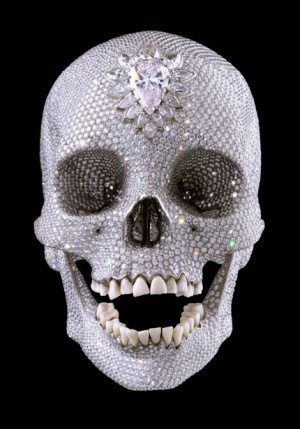
Damien Hirst uses extreme media in his work, by doing this he creates huge attention towards his work, some good, some bad. But Hirst attempts to gain huge attention throughout his artworks. An example of this was the artwork he did called 'For The Love Of God' produced in 2007. This work was a diamond encrused skull with the value of just the materials counting up to $20million and the amount it sold for was $100million. The amount of attention that this work gained from the media was huge and returned back to Hirst as he was the artist giving him self promotion. He is now recognized as an artist that produces shocking work, and enjoys to surround his work aroung the idea of death. 

5. Find 2 images of work by any artist or designer that reflect some of the ideas of individualism, self promotion or egotism that have been discussed on this blog. Upload images to your blog, title and date the work, identify the artist/designer and comment on the work in relation to the question.


Banksy is an exclusive British graffiti artist who has perfected promoting himself without even showing up. Bansky has graffitied all over the world and has become famous for his work but is still unidentifiable. a movie has even been made about his work featuring him but with a blurred out face, it even got into the oscars. His self promotion is through his work, by the simple tagged signature shown above which is under most of his artworks or the stencil style that his works consist of which makes his work identifiable and links it to him.  Banksy  turned a warehouse into a living room for an exhibition and placed a painted elephant to match the wallpaper in the warehouse calling it 'the elephant in the room.' But Banksy himself as never seen. 

6. How do you think artists and designers are viewed in Western society today?
There has been a huge change in the art world in western society throughout time. During the renaissance there were many restrictions to art and the art was all within a common theme, today the limitations and restrictions of art no longer exist. Art work now is recognized as more of an expression. 


7. Comment on the blogs of other students.

8. Reference the websites and/or books you have used, at the end of your blog.
http://dictionary.reference.com/browse/individualism?s=t
http://dictionary.reference.com/browse/egotism?s=t
http://www.worldprintmakers.com/masters/durero/durer.htm

Monday, 2 April 2012


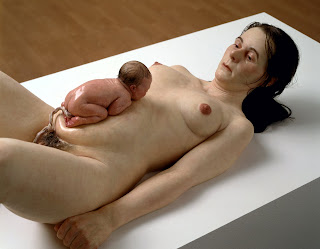
 Ron Mueck's sculpture and Humanism


1. Mueck's sculpture is described as 'hyper-real'. Define the meaning of this term and explain how it is evident in his work.
Taken from the web definition website, hyperreal:  mode of existence in which reality and simulation are experienced as being without difference. In Ron Mueck's work it is clearly evident that he is a hyper-real artist. Once looking at his work, you are able to clearly recognize that he creates reality sculptures, the size or scale may be the only obvious change so you can distinguish it between real life and a sculpture. Every detail is slavishly created to make it as real life as possible, and as yu are able to see in the picture below, it truly is hard to distinguish the reality of it. 

2. Mueck says he is not interested in making life size sculpture. Find out why he is more interested in working with the scale of the figure which is not life size, and mention 2 works which use scale that is either larger or smaller than life.
While researching the reasoning for Mueck to not work in life sized scale i cam across an interview explaining such, the interview by Sarah Tanguy. 
She asked about how he got the idea of manipulating scale of figures , he answered 'i never made like sized figures because it never seemed to be interesting. We meet life sized people everyday.' Here we are able to make the conclusion that Mueck alters scale to raise the emotional and psychological impact. He also says ' it makes you take notice in a way that you wouldn't do with something that is just normal. 

In these two sculptures of Muecks you are able to clearly see how he cleverly is able to still create such realistic people on a different scale. The pregnant women is obviously on a much larger scale as you can tell by the comparison of the lady standing next to her and the two older figures are on a smaller scale. But even by manipulating the scale the detail and skill never seem to change. 

3. Define Renaissance Humanism , and identify which aspects of Humanism can be seen in Mueck's work. Note that the contemporary definition of Humanism is much broader than the Renaissance definition.
Renaissance humanism was a movement in the renaissance period. It was an intellectual and social movement, humanism is a rediscovery and re-evaluation of the aspects of classical civilization and the reapplication of these aspects to intellectual and social culture. The earliest humanists espoused a return to study of the original texts. This caused a move away from the Church as they no longer livd so closely following the regulations of the church but became more individuals. This created a huge change in the art of the time and more detail towards human movement, body language, personality was taken into more consideration. This is related to Ron Mueck's work as you are clearly able to see that he also has taken to the interest of the human body and personality and has created sculptures around it. Mueck has studied the human body and behavior   

4. Research and discuss one of Mueck's sculptures that you might find challenging or exciting to experience in an art gallery. Describe the work, upload an image of the work, and explain your personal response to the work. 
While i was researching for images to put on this blog i came across the sculpture by Ron Mueck 'The Women and Baby'. For me it was challenging looking at the sculpture just in a photo, in real like i believe it would be an astonishing but almost disturbing piece to view. The sculpture is a woman who has just given birth, with the baby laying on her stomach, still attached. The almost scared emotions of the woman's face are almost chilling to look at. I feel uncomfortable to look at this image for so long as i feel this is a more personal experience and should be shared between the mother and child, if i was in an art gallery looking at it i think i would feel out of place and uncomfortable as i shouldn't be there. 
   Ron Mueck mother


http://www.class.uidaho.edu/pop/Glossary.htm
http://www.sculpture.org/documents/scmag03/jul_aug03/mueck/mueck.shtml

Tuesday, 27 March 2012

Damien Hirst's work 'For the Love of God' and Mercantilism


1. Define the work, giving details of form and materials.
'For the Love of God', this is a amazing, jaw dropping piece of art created by Damien Hirst. the form of this art is a platinum casted human skull. but it is not that simple. This human skull has something a little more eye catching to it. The skull is encrusted with 8.601 diamonds. A pear shaped diamond located on the skulls forehead is the centerpiece of the work this is included in the 8.601 diamonds on the skull. 
Damien Hrist’s Diamon Encrusted Skull

2. What does the work mean? What is Damien Hirst communicating in the work?
Hirst's art is commonly surround by the thought of death, this proven true in this artwork. This Piece, being an 18th century skull that was purchased in london. Mexican Skulls encrusted in Turquoise was where the idea erupted from. In an interview he explained, 
'I just want to celebrate life by saying to hell with death. What better way of saying that than by taking the ultimate symbol of death and covering it in the ultimate symbol of luxury, desire and decadence? The only part of the original skull that will remain will be the teeth. You need that grotesque element for it to work as a piece of art. God is in the details and all that.'  The New York Times also interviewed Hirst, he explained, 'I remember thinking it would be great to do a diamond one, but just prohibitively expensive, then i started to think, maybe thats why its a good thing to do. Death is such a heavy subject, it would be good to make something that laughed in the face of it' Here Hirst tells us that the skull is to ironically brighten/lighten a dark subject. I guess using diamonds was the right material then. 

3. How does Hirst's diamond encrusted skull relate to Mercantilism and to conspicuous consumption?
According to the online dictionary, mercantilism also called mercantile system, a theory prevalent in Europe during the 17th and 18th centuries asserting that the wealth of a nation depends on its possession of precious metals and therefore that the government of a nation must maximise the foreign trade surplus, and foster national commercial interests, a merchant marine, the establishment of colonies, etc. This can be related to Damien Hirst's work as the is creating a work to be sold for a larger amount it was made for, this resulting is a profit further realting to wealth. This is common in mercantilism such as exports minus imports. As Hirst was able to create such an expensive artwork with the materials purchased himself, it is clearly shown that he must have an extravagant amount of money, and to do something as amazing as this, it is a clear way to show his wealth. 

4. How much did the work cost, and how much was it sold for, and who bought it?

The work that was produced in 2007 containing 8,601 diamonds was $20million to produce, including materials and fabrication. The pear shaped diamond on the forehead of the life sized skull alone is to be work $4.2million. According to Londons White Cube Gallery where the work was displayed announced that the 'British artist Damien Hirst Diamond encrusted skull sold for $100million dollars.' This artwork was the most expensive artwork ever sold by a living artist and broke records. A group of anonymous investors purchased the work and it is believed the plan to resell the work later for an increased price. 

5. What are some of the differing opinions of the journalists in the newspaper and blog articles?
   What did they think of the work?
When researching i found two prominent opinions, one being a work of genius from one of Britain's most talented artist, the other being a tacky symbol of excess and an art market being 'drunk with money'. But every critic has an opinion of Hirst's diamond encrusted skull, questioning the authenticity of the piece. Hirst hired technicians to create the piece taking 18 months, but Hirst stands by his working making the concept of the art important rather than the work itself. Many believe that the money spent on the work is beyond belief and could have been spent on many other things, they also have said the same work could have been created for less. But on the argumentative side of that, the work would not have the same extravagance to it if it had not had its worth.  Robin Simon, editor of The British Art Journal stated ‘all of Hirst’s works are stunts, but this one is just a more expensive stunt. It’s vacuous nonsense.' 

6. Based on your research, what is your opinion of the work, as an object or a work of art.
My personal opinion on this art work seems to be the same of Robin Simon. As much as i appreciate the time, thought, effort and money put into the artwork, i understand the extravagance and i believe that if i was to see this in person my views may change, but for now i believe that the monetary value has exceeded the worth of true art. I believe this art is memorable for the price rather than the talent and it doesn't have the true beauty and value that other artworks contain.

http://dictionary.reference.com/browse/mercantilism?s=t
http://www.nytimes.com/2007/06/03/magazine/03Style-skull-t.html
http://www.artknowledgenews.com/Damien_Hirst_For_The_Love_Of_God.html

Monday, 19 March 2012

1. First define mercantilism, using material from your ALVC handbook, and explain how it has developed since the Renaissance.
According from the Columbia Encyclopedia, in the 16th, 17th and 18th century the European government declared the wealth of the country depended on its major trading. Therefore Europe had to maximise the trading of precious metals, especially gold as they were in universal demand. 
Foreign trade along with manufacturing and processing were chosen over domestic trade. it has developed since the renaissance as it has now become a world wide trading system. 

2. Identify the ideas or concepts in Hall's work that relate to Mercantilism? 
Fiona Hall, through her work is able to show the issue of Mercantilism though her work. Hall shows this through her materials used, she cleverly uses the material of money to show the wealth that the European Countries wanted to get a hold of. Hall takes the mean of money and changes it so it doesn't show the importance of what is it thought of, she uses the money to form different shapes or to use as a background and so money is no longer the focus. This relates back to Mercantilism as she took the issue and bought th unimportance of wealth to her audiences attention. 

3. For each work describe the shape, form and materials used, and also explain the ideas behind each example.

Fiona Hall realtes her work to mercantilism in various ways. In the below art work 'Leaf Litter' Hall has used various currencies' banknotes and painted a leaf with gouche paint which creates a transparently so you are able to identify the banknotes through the leaf. This idea is related to mercantilism as you are able to see the wanted wealth that Europe was hungry for through the natural materials (which were being sold). the Irony of this work is that the money/wealth that the country was so greedy for was also made form a natural material. 


 ' Leaf Litter' (1999-2003) Fiona Hall


This is another work by Fiona Hall, called tender. the materials used is shredded money moulded into the shapes of birds nest. This strongly is related to economic problem of deforestation as the money we use to destroy the forests in shaped into the homes of the birds which would live in the forest. 


4. In your opinion do the materials communicate the ideas of the work? Please explain your answer. 

i believe that the materials Hall use's are extremely relevant to the work she does. It clearly communicates the idea behind the work. Through the materials Fiona is able to communicate the differences between two worlds, Hall is able to establish the problem at hand and her choice of materials further explain the problem along with the way in which it is made. 


5. Fiona Hall's recent project The Kermadecs focuses on issues around the Pacific ocean. Research this project to summarize the importance of the area and upload an image to your blog for discussion.

The National Geographic Society did a marine census in 2010 and declared the Kermadecs one of the 'last pristine sites left in the ocean' From this a long term goal was formed to uphold this given reputation. Here Hall has used her artwork to demonstrate the marine issue around the pacific ocean. This particular artwork 'shoot the breeze' made in 2011 expresses the loss of loosing a living world. In my opinion i belie this artwork is presented in a way which it is simple fr the viewer to get an idea as to what the meaning is. You are able to clearly establish the fish, then as the eyes naturally move downwards we are then able to make out the can which canned fish is packaged in. the placement is logical and easy to read which creates a good piece of work. 


Kermadec.