Monday, 7 May 2012


1. What and when was the Industrial Revolution?
'The industrial revolution may be defined as the application of power-driven machinery to manufacturing. it had its beginning in remote times, and is still continuing in some places. in the eighteenth century all of western Europe began to industrialize rapidly, but in England the process was most highly accelerated.'

2. Research both Modernist paintings in order to comment on the subject matter, form and style used to celebrate the machine and motion in each painting. Answer the question in 2 parts for each painting.
                                       
                                            
In this painting 'Dynamism of a Dog on a Leash' the subject matter of the moving dog is used to celebrate machine and motion as you are able to visually see a motion on a still image. This was very advanced at the time this was painted as it was very unsual to be able to see motion on a still canvas. This painting was created by multiple strokes to show each motion that would have taken place with the movement of the dogs lega and tail, along with the lead and the walkers feet.  
                                                                       
'The City Rises (or La città che sale in Italien) is a vibrant, colourful Futurist work by Umberto Boccioni from 1910 to 1911 and is painted in oils. It depicts the labours of men on a construction site utilising the power of horses in their labours. It is this power that appears to be the central focus of the painting as the strong horse in a dominating position filling the centre of the composition.  While the construction of a new modern building is the theme of this work, shown by the partially completed building visible in the top right hand corner, it is the strength and energy of the work that comes through. The colours are bold and dramatic, typical of Futurist artworks, shifting from the light yellows of the men in the bottom left to the dark shadows of the central horse. These shadows draw the viewer’s eye into the painting and their mind into the action. Like many other of Boccioni’s paintings The City Rises is energised by the quick successive brushstrokes.'

This painting similar with the form and style as 'Dynamism of a Dog on a Leash' as it also it created to show movement and motion but with a different subject matter. This painting is to show a construction by horses and men. The short brush strokes show the motion as there are so many it comes together as a blur creating the rush that would have been captured within this painting. 

3. Research Cao Fei's RMB City (2007-9)  in order to comment on this work in more depth.
i.e describe the images that has she used in her digital collage that refer to China's present and history, and explain why has she used these images.
                                                                           

                                  Cao Fei's RMB City (2007-9) refers to China's recent rapid industialisation and urbanization.
                                                                (www.artspace.org.nz/exhibitions/2009/cafeintopia.asp)

'Named after Chinese money,RMB City shows a perverse view of Beijing—a blend of communism, socialism, and capitalism. Like Beijing itself, it is constantly under construction, candy-striped smoke stacks suggest continuous industrial production and ships move goods swiftly in and out of port. A giant shopping cart, filled with skyscrapers and religious monuments, floats nearby...Her work is timely and responds to Chinaʼs rapid urbanization and the giddying pace of social and economic development experienced there and ask us to think about the reorganization of social interactions through online and social networking sites' taken from www.scoop.co.nz

This artwork has the subject matter of a view of Beijing. Obviously not a realistic view but more of a symbolic view, it is the artists interpretation of the city. The form and style of the work in my opinion helps to show a celebration to new technology/machinery as it almost looks like a carnival. The bright colours, and the cluttered look help to make it look like things are happening and changing. It shows movement and motion with the smoke in the air giving us a sign that things are being manufactured and with other parts looking like they should be in motion, all of this gives a sense of the industrial revolution.    

4. RMB City is described as a utopia/dystopia. Comment on what these terms mean, and how they can be applied to the work.
According to the online dictionary 'utopia' is a perfect place, especially in social, political and moral aspects, and dystopia is the opposite with everything being as bad as it could possibly be. These can be applied to the work as two different view point. The first being utopia, this work could be viewed in this way as it is a movement towards greater things, it holds a bright happy future with lots a manufacturing and things going on. It shows a successful place as the is happening going on. The opposite view point being dystopia could be applied to the work as it may be looked at as to commercial. Too many machines and manufacturing could be viewed as a negative as the world has become to materialistic and needs to get back to the basics. But both views can be argued for and against the work depending where you come from. 


5. Although the Modernist paintings and the contemporary digital work have emerged from
different contexts, there are also many similarities. Comment on the similarities that you can see in the work. Look at the moving digital image at vimeo.com/4272260, if you have not
already researched it.
I am able to draw comparisons between the works as they both contain a modernistic view in their works, they are just to different extremes. They are both study's showing different changes/movement/motion that are happening. All the artists have captured the movement and have shown them in different forms but all for the same reason of changes. 
6. Comment on other student's blogs.

Rempel, G. (n.d). The Industrial Revolution. Retrieved 29 May, 2006 from http://www.ecology.com/archivedlinks/industrialrevolution/index.html
http://www.scoop.co.nz/stories/CU0906/S00212.ht
http://jade-wildy.suite101.com/futurism-and-umberto-boccionis-the-city-rises-a280519
http://www.thefreedictionary.com/utopia
http://www.thefreedictionary.com/dystopia

Wednesday, 2 May 2012


1. Define the 17th century 'Scientific Revolution', and say how it changed European thought and world view. 
According to Chegg.com the scientific revolution refers to the rapid advances to the European scientific, mathematical and political thought that was based on a new philosophy and faith progress that defined Europe in the 16th and 17th century. It came out of the Renaissance period when the universe was questioned by scientists and the belief process was changed.

2. Give examples of how we can we still see evidence of the 'Scientific Revolution' in the world today.
Today the scientific revolution is still evident as we are continuously seeing 'new' or 'modern' thing, such as technology. Sientific revolution has become very common with new technology such as iphones and new cars etc. i believe that the scientific revolution will never come to an end as new ideas are always evolving and improvements are forever taking place. If they never started the scientific revolution then we would not be where we are today and we would not hold such a promising future. 

Research Pipilotti Rist's video installations to answer the following;

3. From your research, do you think that the contemporary art world values art work
that uses new media/technology over traditional media?
While researching Pipilotti Rist's video installations i found that most people are adapting to the change in the media with a positive outlook. On one blog, the art blog, the have said 'new media is a young artform, but its fresh and engaging, and being experimental it lacka the pomposity that often is attached to traditional art forms.'  here the art blog is for traditional media giving the explanation that it is new and exciting being different from the traditional art forms we are now used to. Looking at comments on the you tube video of her work 'ever is all over' most comments are arguing that her work is 'Beautiful. Fantastic' and ' I love love love love her work' all positive comments giving her work hype. But there are still the odd people that are against the change in the art world saying that she is 'sick minded' and has 'disturbed and traumatized' her viewers. 

4. How has Pipilotti Rist used new media/technology to enhance the audience's experience of her work.
On the web site sport your food.com they have said, 'in these works provocation is a constant and it is created by a playful mix of fantasy and real life where the ongoing movement of the images gives life to a transformation of the subjects, of familiar spaces translated in mesmerizing kaleidoscopes.For the Swiss artist the video images are the projections of emotions and desires, a new form of organic life that will be perceived by every single sense the audience has.' here it explains that Rist's embraces the audience by using spaces that are familiar and not out of the ordinary so you are able to relate to the situation and out yourself in the space easily. She also uses calming music, especially in the video clip Ever is all Over, it is a slow calming relaxing song which tends to mesmerize the audience so they are almost no longer in control of their oen fellings and they are forced to be apart of the video. I felt this when watching Ever is all Over i was unable to stop it, i watched it to the end, even though i wasn't hugely enjoying it, i was just following it until the end. 

5. Comment on how the installation, sound and scale of 'Ever is Over All' (1997) could impact on the audience's experience of the work.
In the clip Ever i all Over the music is very romantic and happy which contrasts to some of what is happening in the clip, the violence of smashing car windows. The music creates a fantasy world which the lady smashing the windows appears to be caught up in, she is oblivious to the fact that she is smashing windows and it to caught up in the music and fantasy of it all. Her complete outfit, the pretty dress and her happiness also gives this feeling to me. The music impacts the audience as i think that it puts the viewers in the same state of mind as the lady walking down the street, the also get engaged into the fantasy land and no longer have a say but they just follow the video.
 
6. Comment on the notion of 'reason' within the content of the video. Is the woman's behaviour reasonable or unreasonable?
The behavior of the woman is strange to me, it was unexpected that with the romantic music a pretty women in a dress walking down a street carrying a flower would out of the blue strike at a car with the flower and smash the window. It was a shock for me to see this and confused me, i thought it was unreasonable. While watching the video there did not seem to be a good enough reason to just randomly break parked cars windows. When the female police officer then walks behind the lady you expect an arrest or at least a form of constraint to stop the ladies behavior but nothing but a wave from the officer makes the behavior of the women almost seem as if it is reasonable or else the officer would have done otherwise. It is a split view, the audience may seem her behavior to be unreasonable but if an authority doesn't seem to mind this behavior it makes you re think, maybe it wasn't unreasonable?

7. Comment on your 'reading' (understanding) of the work by discussion the aesthetic (look), experience and the ideologies (ideas, theories) of the work.
My understanding of the work is that is shows a feminist view using romantic music and a pretty lady in a dress , which contrasts with the violence used when smashing the windows. The look of the video is interesting with the two different videos happening in one, the main video of the lady and the side video of the close-up of the flowers, this makes the video interesting and exciting you can flick between the two videos. The idea's behind the work as i said before is the feminist views. Also another theory could be to make the viewer feel as if they are apart of the video to make the experienced shared between the viewers and the actress in the video. I found the video very interesting and excitingly different. I had not experienced an art video like this before and it was very enjoyable for me. 


http://www.theartblog.org/2012/02/new-media-art-white-hot-gold-at-murray-state/
http://www.chegg.com/
http://www.sportyourfood.com/en/Parasimpatico.-The-Nicola-Trussardi-Foudation-presents-Pipilotti-Rist/ 

Thursday, 26 April 2012


1.Define the Enlightenment, including its context (time and place).
'The Enlightenment is generally described as taking place during the 18Th. century and is centered in france. Like the Renaissance, the values and ideas developed during the period of the Enlightenment are described as having a major influence on current ways of thinking in the west and therefore the production of contemporary western visual culture.' -taken from the ALVC book, page 91. 
Other points taken from the ALCV handbook describing the Enlightenment are
-A characteristic bundle of ideas
-An intellectual movement 
-A communicating group of intellectuals
-A set of institutional centres where intellectuals clustered
-A publishing industry, and an audience for its output
-An intellectual fashion
-A belief system
-A history and a geography
 
2. Define the concept of the Sublime.
The sublime was is the ultimate experience of divinity, a mixture of awe, fear and enlightenment produced by the contemplation of a powerful, terrifying nature. 

3. Explain how the concept of the Sublime came out of Enlightenment thought.


4. Discuss the subject matter, and aesthetic (look) of Misrach's work to identify the Sublime in his work. Include some quotes from art critics and other writers who have written about his work. 
5. Add 2 new images of his work to your blog.
6. Describe how does Misrach's photography makes you feel. How does it appeal to your imagination?
7. Identify some other artists or designers that work with ideas around the Sublime, from the Enlightenment era as well as contemporary artists.
8. Add a Sublime image of your choice to your blog, which can be Art or just a Sublime photograph.
9. Reference your sources (books and websites).


http://europeanhistory.about.com/od/referenceencyclopedia/g/glenlightenment.htm

Sunday, 15 April 2012


The Social Status of the Artist - The Renaissance and Now 


1. Identify aspects of Durer's self portrait that show a changing view of the artist's view of himself as an individual.
Durer began painting self portraits when he was as young as 13. The below self portrait of Durer is oil on wood (1500). By centering himself in the middle of the painting and having clear symmetry present it creates a feeling of power. Most self portraits of this time were to show wealth and power, but this one seems to show or resemble some one else. In the painting the image of Jesus is able to be identified, by the long hair, and the pose of his hand. Durer believed that 'God created man in his own image' this being the reasoning of the commonality between the two. I have included a painting of Jesus Christ so you are abel to clearly establish the similarities between the two and see how Durer based his own oil painting on. In this self portrait, as Durer has placed himself in the image of God (as God created man) it changes the view of the artist as he has not incorporated aspects of himself in his self portrait. In this painting he hasn't aimed to become the centre of attention but he has viewed himself as an image of God.  
Dürer, self portrait at 28
2. Explain how the artist's social status increased during the Renaissance period. Briefly explain why this happened.
Durer's social status increased over the Renaissance period as he had an arranged marriage. Durer married the daughter of a wealthy machine and instrument maker. Later his social status increased again when he continuously painted self portraits, this showed the changed in his status as time went by, it was almost a documentation of his social status through paintings. This was such a change as it was not common to have self portraits the main theme of your work during the Renaissance. 
3. Comment on Gavin Turk's work in relation to individualism, status of the artist and egotism.
according to the online dictionary  the meaning of both egotism and individualism are below:
egotismexcessive and objectionable reference to oneself in conversation or writing; conceit; boastfulness. 
individualism-a social theory advocating the libertyrights, or independent action of the individual. 

Gavin Turk's work is very self reflective. Looking through his art work he promotes himself through his work. Examples of this are his works that he has used purely his signature, nothing else. Also creating wax models and himself dressed like Elvis Presley. By doing this it clearly shows egotism as he is continuously referencing himself in his art work as his was of promotion. Individualism is shown as he is not relying on anything but himself to create his art work, it is solely based on himself. 

4. Comment on Damien Hirst's use of his work and the media for self promotion.
Damien Hirst uses extreme media in his work, by doing this he creates huge attention towards his work, some good, some bad. But Hirst attempts to gain huge attention throughout his artworks. An example of this was the artwork he did called 'For The Love Of God' produced in 2007. This work was a diamond encrused skull with the value of just the materials counting up to $20million and the amount it sold for was $100million. The amount of attention that this work gained from the media was huge and returned back to Hirst as he was the artist giving him self promotion. He is now recognized as an artist that produces shocking work, and enjoys to surround his work aroung the idea of death. 

5. Find 2 images of work by any artist or designer that reflect some of the ideas of individualism, self promotion or egotism that have been discussed on this blog. Upload images to your blog, title and date the work, identify the artist/designer and comment on the work in relation to the question.


Banksy is an exclusive British graffiti artist who has perfected promoting himself without even showing up. Bansky has graffitied all over the world and has become famous for his work but is still unidentifiable. a movie has even been made about his work featuring him but with a blurred out face, it even got into the oscars. His self promotion is through his work, by the simple tagged signature shown above which is under most of his artworks or the stencil style that his works consist of which makes his work identifiable and links it to him.  Banksy  turned a warehouse into a living room for an exhibition and placed a painted elephant to match the wallpaper in the warehouse calling it 'the elephant in the room.' But Banksy himself as never seen. 

6. How do you think artists and designers are viewed in Western society today?
There has been a huge change in the art world in western society throughout time. During the renaissance there were many restrictions to art and the art was all within a common theme, today the limitations and restrictions of art no longer exist. Art work now is recognized as more of an expression. 


7. Comment on the blogs of other students.

8. Reference the websites and/or books you have used, at the end of your blog.
http://dictionary.reference.com/browse/individualism?s=t
http://dictionary.reference.com/browse/egotism?s=t
http://www.worldprintmakers.com/masters/durero/durer.htm

Monday, 2 April 2012


 Ron Mueck's sculpture and Humanism


1. Mueck's sculpture is described as 'hyper-real'. Define the meaning of this term and explain how it is evident in his work.
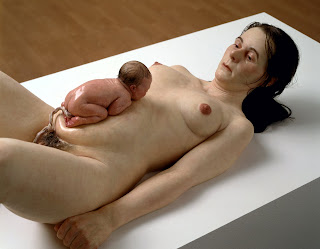
Taken from the web definition website, hyperreal:  mode of existence in which reality and simulation are experienced as being without difference. In Ron Mueck's work it is clearly evident that he is a hyper-real artist. Once looking at his work, you are able to clearly recognize that he creates reality sculptures, the size or scale may be the only obvious change so you can distinguish it between real life and a sculpture. Every detail is slavishly created to make it as real life as possible, and as yu are able to see in the picture below, it truly is hard to distinguish the reality of it. 

2. Mueck says he is not interested in making life size sculpture. Find out why he is more interested in working with the scale of the figure which is not life size, and mention 2 works which use scale that is either larger or smaller than life.
While researching the reasoning for Mueck to not work in life sized scale i cam across an interview explaining such, the interview by Sarah Tanguy. 
She asked about how he got the idea of manipulating scale of figures , he answered 'i never made like sized figures because it never seemed to be interesting. We meet life sized people everyday.' Here we are able to make the conclusion that Mueck alters scale to raise the emotional and psychological impact. He also says ' it makes you take notice in a way that you wouldn't do with something that is just normal. 

In these two sculptures of Muecks you are able to clearly see how he cleverly is able to still create such realistic people on a different scale. The pregnant women is obviously on a much larger scale as you can tell by the comparison of the lady standing next to her and the two older figures are on a smaller scale. But even by manipulating the scale the detail and skill never seem to change. 

3. Define Renaissance Humanism , and identify which aspects of Humanism can be seen in Mueck's work. Note that the contemporary definition of Humanism is much broader than the Renaissance definition.
Renaissance humanism was a movement in the renaissance period. It was an intellectual and social movement, humanism is a rediscovery and re-evaluation of the aspects of classical civilization and the reapplication of these aspects to intellectual and social culture. The earliest humanists espoused a return to study of the original texts. This caused a move away from the Church as they no longer livd so closely following the regulations of the church but became more individuals. This created a huge change in the art of the time and more detail towards human movement, body language, personality was taken into more consideration. This is related to Ron Mueck's work as you are clearly able to see that he also has taken to the interest of the human body and personality and has created sculptures around it. Mueck has studied the human body and behavior   

4. Research and discuss one of Mueck's sculptures that you might find challenging or exciting to experience in an art gallery. Describe the work, upload an image of the work, and explain your personal response to the work. 
While i was researching for images to put on this blog i came across the sculpture by Ron Mueck 'The Women and Baby'. For me it was challenging looking at the sculpture just in a photo, in real like i believe it would be an astonishing but almost disturbing piece to view. The sculpture is a woman who has just given birth, with the baby laying on her stomach, still attached. The almost scared emotions of the woman's face are almost chilling to look at. I feel uncomfortable to look at this image for so long as i feel this is a more personal experience and should be shared between the mother and child, if i was in an art gallery looking at it i think i would feel out of place and uncomfortable as i shouldn't be there. 
   Ron Mueck mother


http://www.class.uidaho.edu/pop/Glossary.htm
http://www.sculpture.org/documents/scmag03/jul_aug03/mueck/mueck.shtml

Tuesday, 27 March 2012

Damien Hirst's work 'For the Love of God' and Mercantilism


1. Define the work, giving details of form and materials.
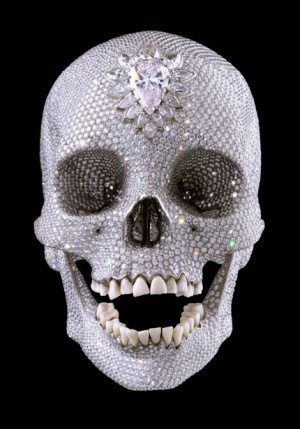
'For the Love of God', this is a amazing, jaw dropping piece of art created by Damien Hirst. the form of this art is a platinum casted human skull. but it is not that simple. This human skull has something a little more eye catching to it. The skull is encrusted with 8.601 diamonds. A pear shaped diamond located on the skulls forehead is the centerpiece of the work this is included in the 8.601 diamonds on the skull. 
Damien Hrist’s Diamon Encrusted Skull

2. What does the work mean? What is Damien Hirst communicating in the work?
Hirst's art is commonly surround by the thought of death, this proven true in this artwork. This Piece, being an 18th century skull that was purchased in london. Mexican Skulls encrusted in Turquoise was where the idea erupted from. In an interview he explained, 
'I just want to celebrate life by saying to hell with death. What better way of saying that than by taking the ultimate symbol of death and covering it in the ultimate symbol of luxury, desire and decadence? The only part of the original skull that will remain will be the teeth. You need that grotesque element for it to work as a piece of art. God is in the details and all that.'  The New York Times also interviewed Hirst, he explained, 'I remember thinking it would be great to do a diamond one, but just prohibitively expensive, then i started to think, maybe thats why its a good thing to do. Death is such a heavy subject, it would be good to make something that laughed in the face of it' Here Hirst tells us that the skull is to ironically brighten/lighten a dark subject. I guess using diamonds was the right material then. 

3. How does Hirst's diamond encrusted skull relate to Mercantilism and to conspicuous consumption?
According to the online dictionary, mercantilism also called mercantile system, a theory prevalent in Europe during the 17th and 18th centuries asserting that the wealth of a nation depends on its possession of precious metals and therefore that the government of a nation must maximise the foreign trade surplus, and foster national commercial interests, a merchant marine, the establishment of colonies, etc. This can be related to Damien Hirst's work as the is creating a work to be sold for a larger amount it was made for, this resulting is a profit further realting to wealth. This is common in mercantilism such as exports minus imports. As Hirst was able to create such an expensive artwork with the materials purchased himself, it is clearly shown that he must have an extravagant amount of money, and to do something as amazing as this, it is a clear way to show his wealth. 

4. How much did the work cost, and how much was it sold for, and who bought it?

The work that was produced in 2007 containing 8,601 diamonds was $20million to produce, including materials and fabrication. The pear shaped diamond on the forehead of the life sized skull alone is to be work $4.2million. According to Londons White Cube Gallery where the work was displayed announced that the 'British artist Damien Hirst Diamond encrusted skull sold for $100million dollars.' This artwork was the most expensive artwork ever sold by a living artist and broke records. A group of anonymous investors purchased the work and it is believed the plan to resell the work later for an increased price. 

5. What are some of the differing opinions of the journalists in the newspaper and blog articles?
   What did they think of the work?
When researching i found two prominent opinions, one being a work of genius from one of Britain's most talented artist, the other being a tacky symbol of excess and an art market being 'drunk with money'. But every critic has an opinion of Hirst's diamond encrusted skull, questioning the authenticity of the piece. Hirst hired technicians to create the piece taking 18 months, but Hirst stands by his working making the concept of the art important rather than the work itself. Many believe that the money spent on the work is beyond belief and could have been spent on many other things, they also have said the same work could have been created for less. But on the argumentative side of that, the work would not have the same extravagance to it if it had not had its worth.  Robin Simon, editor of The British Art Journal stated ‘all of Hirst’s works are stunts, but this one is just a more expensive stunt. It’s vacuous nonsense.' 

6. Based on your research, what is your opinion of the work, as an object or a work of art.
My personal opinion on this art work seems to be the same of Robin Simon. As much as i appreciate the time, thought, effort and money put into the artwork, i understand the extravagance and i believe that if i was to see this in person my views may change, but for now i believe that the monetary value has exceeded the worth of true art. I believe this art is memorable for the price rather than the talent and it doesn't have the true beauty and value that other artworks contain.

http://dictionary.reference.com/browse/mercantilism?s=t
http://www.nytimes.com/2007/06/03/magazine/03Style-skull-t.html
http://www.artknowledgenews.com/Damien_Hirst_For_The_Love_Of_God.html